Brisbane apartments buying is a question that comes up often from people looking at the inner city, and it is a subject where the material in circulation is uneven. Much of it is project marketing, or general market commentary written about another city and applied to Brisbane without being rechecked against Brisbane data.
This article sets out the inner-city Brisbane apartment market as the official statistics describe it: who lives there, how the tenure structure breaks down, where new supply is heading, and how the city is planning the centre. There are no prices, no price forecasts and no tax figures anywhere in it.
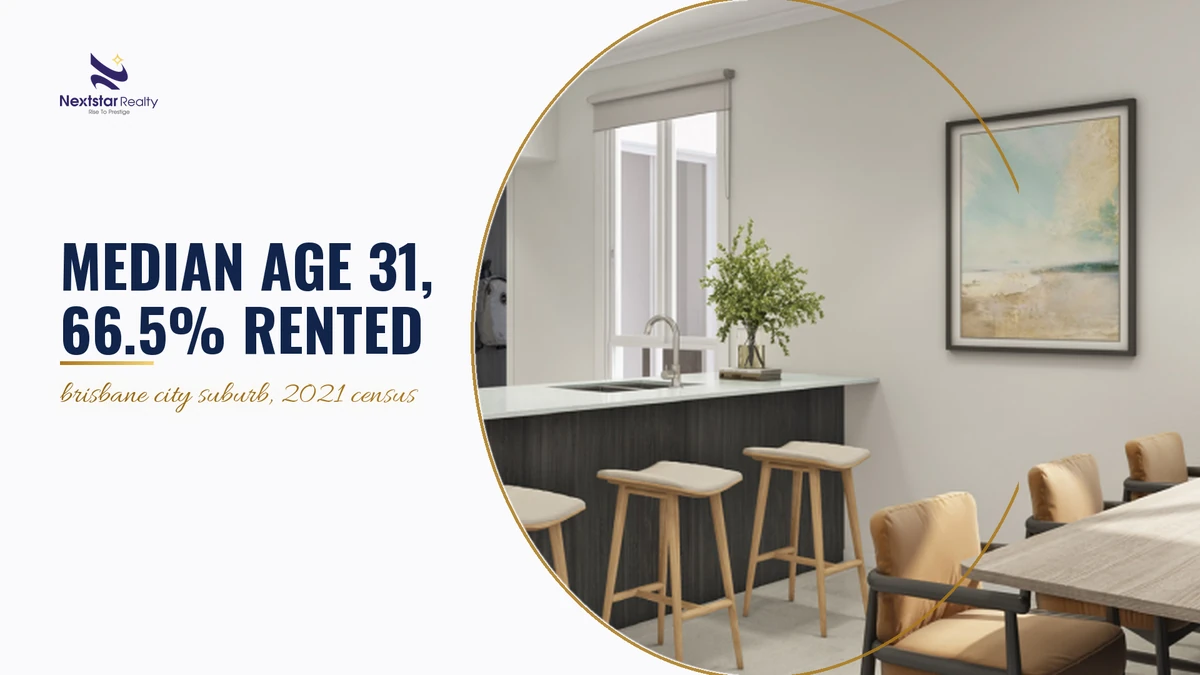
Quick summary: in the Brisbane City suburb — the inner-city core — 98.9 per cent of occupied private dwellings were flats or apartments at the 2021 Census, against 12.5 per cent of occupied private dwellings across Queensland. Median age 31, average household size 1.8 people, and 66.5 per cent of occupied private dwellings were rented. On new supply, dwelling units approved in Queensland in the “other” category — everything that is not a house — went from 13,779 in financial year 2024-25 to 21,377 in 2025-26. Brisbane City Council states that its City Plan review will support the delivery of 210,800 dwellings by 2046, as required by ShapingSEQ benchmarks. These are demographic and supply figures, not price indicators.

Apartments are 98.9 per cent of occupied private dwellings in the city core
This figure is worth pausing on, because it is nothing like the rest of the city. The statistical unit matters here: the Census counts occupied private dwellings, meaning dwellings with people in residence on Census night, not every dwelling that physically exists.
| Dwelling structure | Brisbane City suburb | Queensland | Australia |
|---|---|---|---|
| Flat or apartment | 98.9% (5,518) | 12.5% | 14.2% |
| Separate house | 0.1% (4) | 74.8% | 72.3% |
| Semi-detached, row or terrace house, townhouse | 0.1% (5) | 11.7% | 12.6% |
The percentages above are shares of occupied private dwellings in each area at the 2021 Census. The suburb recorded 5,578 occupied private dwellings in total, and within that count there were four separate houses. If you are looking for a separate house in the Brisbane city core, the count of that dwelling type in this suburb is very small.
On apartment size, the same Census release records 1,704 occupied private dwellings in the suburb with one bedroom, and 95 with no bedroom, which is the category that captures studio layouts.
Buying into an apartment building in Queensland also generally means becoming a member of the body that runs the scheme, with shared running costs and a set of by-laws. What that body is and what it decides is covered separately in our article on what a body corporate is in Queensland.
Who lives in inner-city Brisbane apartments
The resident profile recorded at the 2021 Census sits alongside that dwelling mix. All of the figures below are for the Brisbane City suburb, with the Queensland figure given for comparison.
- Median age 31, compared with a median age of 38 for Queensland.
- Average household size 1.8 people, compared with 2.5 people for Queensland — so mostly one and two person households.
- 0.7 motor vehicles per dwelling on average, compared with 1.9 per dwelling for Queensland.
- 39.3 per cent of people were born in Australia, compared with 71.4 per cent for Queensland. The overseas countries of birth listed for the suburb are China (excluding SARs and Taiwan) 8.3 per cent, South Korea 4.2 per cent, India 3.5 per cent, England 3.4 per cent and New Zealand 2.9 per cent.
- Among languages used at home other than English, the page lists Mandarin at 10.6 per cent, then Korean 3.9 per cent, Spanish 3.6 per cent, Cantonese 2.7 per cent and Thai 1.7 per cent.
Note: Vietnamese is not among the five languages listed on the 2021 Census QuickStats page for the Brisbane City suburb, so that page does not publish a count for it. A nearby suburb where the 2021 Census does publish a Vietnamese figure is South Brisbane: 218 people used Vietnamese at home, or 1.5 per cent of that suburb’s 14,292 people.
Two thirds of occupied private dwellings were rented. The tenure breakdown for the Brisbane City suburb at the 2021 Census: rented 66.5 per cent, owned outright 15.4 per cent, owned with a mortgage 15.4 per cent. The Queensland figures on the same measure are rented 33.1 per cent, owned outright 29.1 per cent and owned with a mortgage 34.4 per cent.
Approvals for dwelling units other than houses are rising
This is one of the more useful series for following building approval activity, and it is published on a regular schedule rather than being a one-off release.
The Australian Bureau of Statistics splits approved dwelling units into two groups: houses, and everything else, which covers apartments, units and attached dwellings. The Queensland Government Statistician’s Office publishes that series for Queensland by financial year. The five most recent financial years:
| Financial year | Houses | Other (mainly apartments and units) | Total |
|---|---|---|---|
| 2021-22 | 24,429 | 14,040 | 38,469 |
| 2022-23 | 21,496 | 14,600 | 36,096 |
| 2023-24 | 21,766 | 11,229 | 32,995 |
| 2024-25 | 24,641 | 13,779 | 38,420 |
| 2025-26 | 27,207 | 21,377 | 48,584 |
The “other” group went from 11,229 dwelling units approved in 2023-24 to 13,779 in 2024-25 and 21,377 in 2025-26. The total of 48,584 dwelling units approved in 2025-26 is the highest of the five financial years shown in the table above. The series itself runs back to 1983-84 and contains higher totals than that in earlier years, so the comparison here is limited to these five rows.
Note: two qualifications apply, and both matter. First, this is a whole-of-Queensland series, not a Brisbane one — the table we used does not break the figures down by local government area, so it cannot be read as a count for the City of Brisbane. Second, an approval is a procedural step, not a completed dwelling.
How the city is planning the centre
On its official housing supply page, Brisbane City Council states that its continual review of Brisbane City Plan 2014 “will support the delivery of 210,800 dwellings by 2046, as required by ShapingSEQ benchmarks”. The same page describes encouraging generous balconies and communal areas in new residential buildings to support outdoor living, through City Plan provisions.
The Council’s More Homes, Sooner program is directed at the low-medium density residential zone. The Council states that the LMR zone makes up 14 per cent of Brisbane’s residential areas and includes small parts of a range of suburbs.
For the core itself, the City Centre neighbourhood plan code lists the overall outcomes sought for the area. Among them: compact, high density building forms contained by the city loop of the Brisbane River, Spring Hill and Roma Street Parklands; a compact City Centre with built form characterised by high rise office and residential towers; the lowest levels of new developments occupied by retail, commercial or community uses close to the pedestrian public realm; and a reduced dependence on private vehicle usage with increased reliance on public transport, cycling and walking.
Note: the version of the City Centre neighbourhood plan code we were able to access is City Plan 2014 version v02_00, dated 19 February 2016. For a specific lot, the planning provisions in force at the time should be checked rather than assumed from this article.
A group the housing data rarely names: international students
Brisbane records a substantial number of international student enrolments, and the official education statistics allow both the scale and the source-market mix to be read directly rather than guessed at.
According to the Study Queensland international education and training snapshot for Brisbane, the city recorded 99,300 international student enrolments in 2024, 2 per cent higher than 2023. Within that total, higher education accounted for 41,203 enrolments, vocational education and training 33,681, English language courses for overseas students 18,872, non-award programs 3,136 and schools 2,408.
The two source markets with the highest enrolment counts in Brisbane in 2024 were China, with 20,648 enrolments (21 per cent), and India, with 12,310 enrolments (12 per cent). The snapshot states that these two together accounted for 33 per cent of total enrolments. Within Brisbane’s top five source markets, China and the Philippines were the two that recorded enrolment growth between 2023 and 2024, with Philippines enrolments growing by 33 per cent.
At state level, total international student enrolments in Queensland in 2024 were 157,658, 7 per cent higher than 2023. Trade and Investment Queensland states that Vietnam ranks eleventh among Queensland’s source markets for international student enrolments, with 3,486 enrolments as at December 2025.
If you are looking at this from the student side, the rules that apply to buying while on a student visa are set out in our article on international students buying property in Australia.
Four questions to answer before you inspect any apartment
This is the practical part, and each of the four questions can be answered before you start booking inspections.
- Whether you are buying to live in or to rent out. The two paths have different consequences for cash flow and for the kind of apartment that suits. Nextstar Realty does not make that call on your behalf.
- What kind of scheme the building sits in. Apartments in Australia generally sit inside a shared ownership structure, which means shared running costs and a set of internal rules. Reading and interpreting those records should be handled by a solicitor or a suitably qualified legal or conveyancing professional, within the scope of their registration. Nextstar Realty does not provide legal advice.
- Your tax position. This article deliberately carries no tax figures. Tax questions should be discussed with a tax agent registered with the Tax Practitioners Board, within the scope of their registration.
- How much you borrow. Nextstar Realty does not hold an Australian Credit Licence and does not provide credit assistance. Borrowing should be discussed with a licensed mortgage broker or with your bank, within the scope of their licence.
If you are at the earlier stage of deciding whether an apartment is the right property type at all, our article on a new build compared with an established home sets the two side by side on build standards and running costs.
The regular contribution to the scheme is one of the numbers worth asking about early, and how it is set is covered in our article on body corporate fees in Queensland.
Frequently asked questions about Brisbane apartments
Are there any houses in the Brisbane city core?
Very few. At the 2021 Census the Brisbane City suburb recorded 4 separate houses among 5,578 occupied private dwellings, or 0.1 per cent. Flats or apartments made up 98.9 per cent of occupied private dwellings, at 5,518.
Separately, the City Centre neighbourhood plan code lists compact, high density building forms among the overall outcomes sought for the area. Both of those things are the case. Buyers who need a separate house generally look beyond this suburb.
What share of inner-city apartments is rented?
At the 2021 Census, 66.5 per cent of occupied private dwellings in the Brisbane City suburb were rented, compared with 33.1 per cent of occupied private dwellings across Queensland. Owned outright was 15.4 per cent and owned with a mortgage 15.4 per cent.
That tenure structure sits alongside the resident profile for the same suburb: median age 31, average household size 1.8 people, and 39.3 per cent of people born in Australia.
Is new apartment supply in Queensland rising or falling?
Rising, on the approvals series. Dwelling units approved in Queensland in the “other” category — everything that is not a house — went from 11,229 in financial year 2023-24 to 13,779 in 2024-25 and 21,377 in 2025-26.
Total dwelling units approved in 2025-26 came to 48,584, the highest of the five financial years shown in the table above. Two qualifications: this is a whole-of-Queensland series rather than a Brisbane one, and an approval is not a completed dwelling.
Do many Vietnamese speakers live in central Brisbane?
Vietnamese is not among the five languages listed on the 2021 Census QuickStats page for the Brisbane City suburb, so that page does not publish a separate count for it. The language listed first on that page is Mandarin, at 10.6 per cent.
A nearby suburb where a Vietnamese figure is published is South Brisbane, with 218 people using Vietnamese at home, or 1.5 per cent of that suburb’s population.
Does Nextstar sell apartments?
Nextstar Realty holds a real estate licence in Queensland and works on new homes and house and land packages. You can see the current list of projects on our Projects page to understand what type of product is available at the moment.
For any apartment, reading the scheme records and the contract should be handled by a solicitor or a suitably qualified legal or conveyancing professional, within the scope of their registration, and the tax side belongs with a registered tax agent. Nextstar Realty does not provide legal advice.
Next steps
For an inner-city apartment, a workable order is: settle what you are buying it for, have a solicitor look at the building’s records, take the tax and borrowing questions to the people licensed to answer them, and only then start looking at specific apartments.
If you already have a particular apartment in mind, our article on buying a body corporate property sets out the documents a seller is required to give you before you sign.
Nextstar Realty works on new homes and house and land packages in Queensland. You can see what is currently available on our Brisbane projects page.
About Nextstar Realty
Nextstar Realty (Nextstar Investment Group Pty Ltd) is a licensed real estate agency in Queensland, based in Rocklea, Brisbane. It sells new-build homes in Brisbane, Queensland, including house and land packages, townhouses and new apartments, and works with buyers in Vietnamese and English. Articles on this blog are general information and cite government sources. Nextstar does not provide legal, financial or tax advice. You can see the projects currently for sale or book a consultation.
Sources
- Australian Bureau of Statistics — 2021 Census QuickStats, Brisbane City (SAL30379), data as at Census night, 10 August 2021
- Australian Bureau of Statistics — 2021 Census QuickStats, South Brisbane (SAL32587), data as at Census night, 10 August 2021
- Australian Bureau of Statistics — 2021 Census QuickStats, Queensland, data as at Census night, 10 August 2021
- Queensland Government Statistician’s Office — Building approvals: dwelling units approved by type, Queensland, 1983-84 to 2025-26, last updated 30 July 2026; based on original series as at June 2026; source ABS, Building Approvals, Australia
- Brisbane City Council — Housing supply, including the More Homes, Sooner material last modified February 2026
- Brisbane City Council — City Centre neighbourhood plan code, City Plan 2014 version v02_00, dated 19 February 2016
- Study Queensland — International education and training snapshot: Brisbane 2024, publication date August 2025
- Study Queensland — International education and training snapshot: Queensland 2024, publication date August 2025
- Trade and Investment Queensland — Vietnam market profile, enrolment figure as at December 2025
- Queensland Government Statistician’s Office — Building approvals: dwelling units by type, Queensland
- Brisbane City Council — Housing supply
Note on scope and timing: the figures above were checked against these sources on 8 September 2026. Census figures describe Census night, 10 August 2021, and are now five years old. The building approvals series is for the whole of Queensland rather than Brisbane alone. The version of the City Centre neighbourhood plan code we were able to access is dated 19 February 2016. For a specific property, the provisions in force at the time should be confirmed by a solicitor or a suitably qualified legal or conveyancing professional, within the scope of their registration, before anything in this article is relied on. Nextstar Realty does not provide legal advice.
This article is general information only and does not take into account your personal circumstances, financial situation or objectives. It is not legal, financial or taxation advice. You should obtain independent professional advice before making any property decision.